eSIM API Integration Guide: Provision eSIMs Programmatically
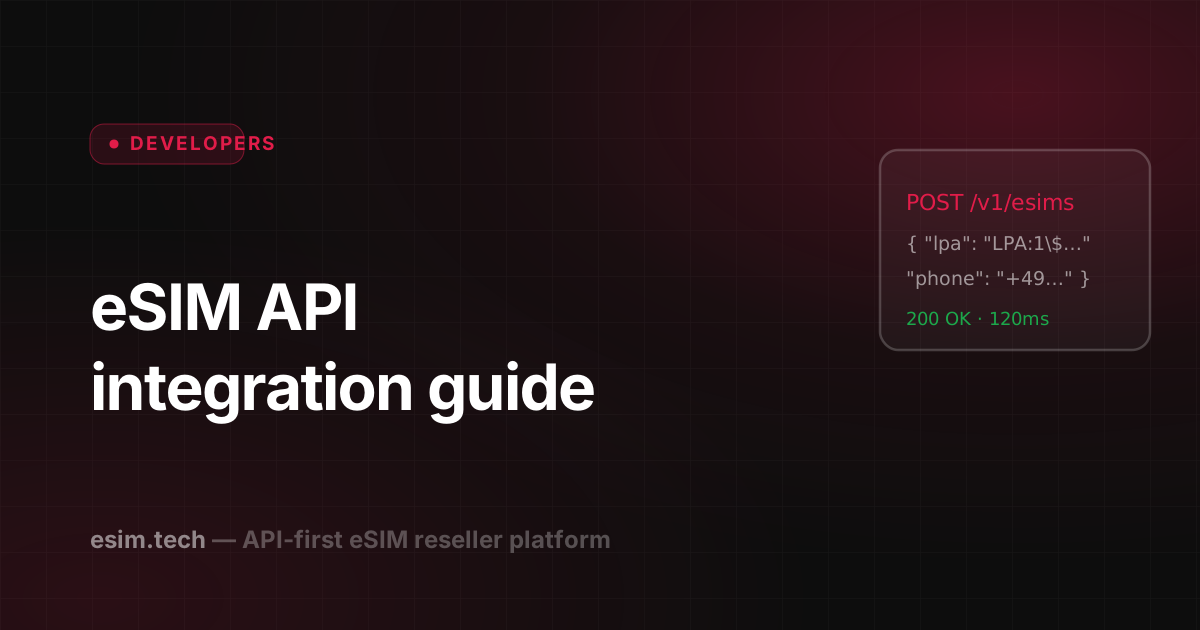
Integrating an eSIM API is one of the highest-leverage features a travel or telecom product can ship: a few endpoints turn your checkout into a connectivity store. This guide covers the full integration — provisioning, delivery, webhooks, and the edge cases worth handling — from a developer’s perspective.
The core flow
Every eSIM reseller integration reduces to three steps:
1. Customer pays          →  your checkout
2. Provision the eSIM     →  POST /v1/esims
3. Deliver the QR code    →  confirmation page + email
Provisioning
When payment succeeds, your backend makes one call:
curl -X POST https://api.esim.tech/v1/esims \
  -H "Authorization: Bearer sk_live_..." \
  -H "Content-Type: application/json" \
  -d '{
    "product": "local-nl-unlimited",
    "reference": "order_8412"
  }'
The response returns everything you need, immediately:
{
  "id": "esim_L4nX...",
  "iccid": "8931089...",
  "lpa": "LPA:1$smdp.esim.tech$K9MX-....",
  "phone_number": "+31612345678",
  "status": "ready",
  "created_at": "2026-07-02T09:41:12Z"
}
Two things matter here. First, the LPA code is in the response — no polling, no email, no async job. At ~120ms end-to-end you can call it synchronously inside checkout. Second, for local eSIM products, the phone number arrives in the same response, so you can show the customer their new local number before they’ve even scanned the QR code.
Delivery
Render the LPA string as a QR code (any QR library; the string is the payload) and:
- Show it on the confirmation page
- Email it as a fallback (customers often install later, on Wi-Fi)
- On mobile, also offer the universal-link install flow so same-device users don’t need a second screen to scan from
Lifecycle webhooks
Register a webhook endpoint and you’ll receive events like:
{ "type": "esim.activated",   "esim": "esim_L4nX", "at": "..." }
{ "type": "usage.threshold",  "esim": "esim_L4nX", "used_mb": 4096, "threshold": 0.8 }
{ "type": "balance.low",      "esim": "esim_L4nX", "remaining_mb": 512 }
The balance.low event is your revenue engine: trigger a one-click top-up email and you monetise the moment of highest intent. Resellers automating this typically see 20–30% extra revenue per customer.
Design decisions worth getting right
Idempotency. Pass your order ID as reference and retry safely on network failures — you never want to provision (and pay for) two eSIMs for one order.
Provision at payment, not before. eSIMs are billed when provisioned. Don’t pre-generate them for abandoned carts.
Store the ICCID. It’s the stable identifier you’ll use for support, top-ups, and usage queries.
Handle the “can my phone do this?” question early. Check eSIM device compatibility in your UI before checkout, not in a refund email after.
Product types you can provision
One integration gives you the full catalogue:
- Pay-as-you-go data — per-MB billing, top-ups via API, 190+ countries
- Local eSIMs — real local phone number + voice + SMS + (unlimited) data in 25+ countries
- EU data bundles — up to 500 GB for routers, campers, and fleets across the EU
- 5G backup — failover connectivity for fixed locations
Same API shape for all of them — only the product identifier changes, so expanding your line-up later is a config change, not a project. If you’re evaluating the business side first, start with how to become an eSIM reseller.
Going live
- Create your account at resellers.esim.tech
- Integrate provisioning + QR rendering against the sandbox
- Wire the webhook endpoint (activation + low balance at minimum)
- Test the full install flow on a real iPhone and a real Android device
- Switch to live keys and ship
Authentication is a standard Bearer token, the API is plain REST/JSON, and there are no minimum volumes — your first provisioned eSIM can be a production customer.
Frequently asked questions
What is an LPA code?
The LPA (Local Profile Assistant) code is the activation string an eSIM-capable device uses to download its SIM profile. It's usually presented as a QR code. Format: LPA:1$smdp.example.com$ACTIVATION-CODE. When your API returns it instantly, you can show the QR code directly in your checkout flow.
How fast is eSIM provisioning via API?
On eSIM.tech, a POST /v1/esims call returns the LPA code and ICCID in roughly 120 milliseconds end-to-end — fast enough to provision synchronously during checkout.
Do I need special telecom knowledge to integrate an eSIM API?
No. If you can integrate a payment API, you can integrate an eSIM API. The telecom complexity (SM-DP+ servers, operator agreements, profile generation) is abstracted behind the REST interface.
How do customers install the eSIM?
They scan the QR code you display (or tap a universal link on the same device). iOS and Android then download and install the profile. A good install guide per platform dramatically reduces support tickets.