Travel eSIM vs Local eSIM: What's the Difference?
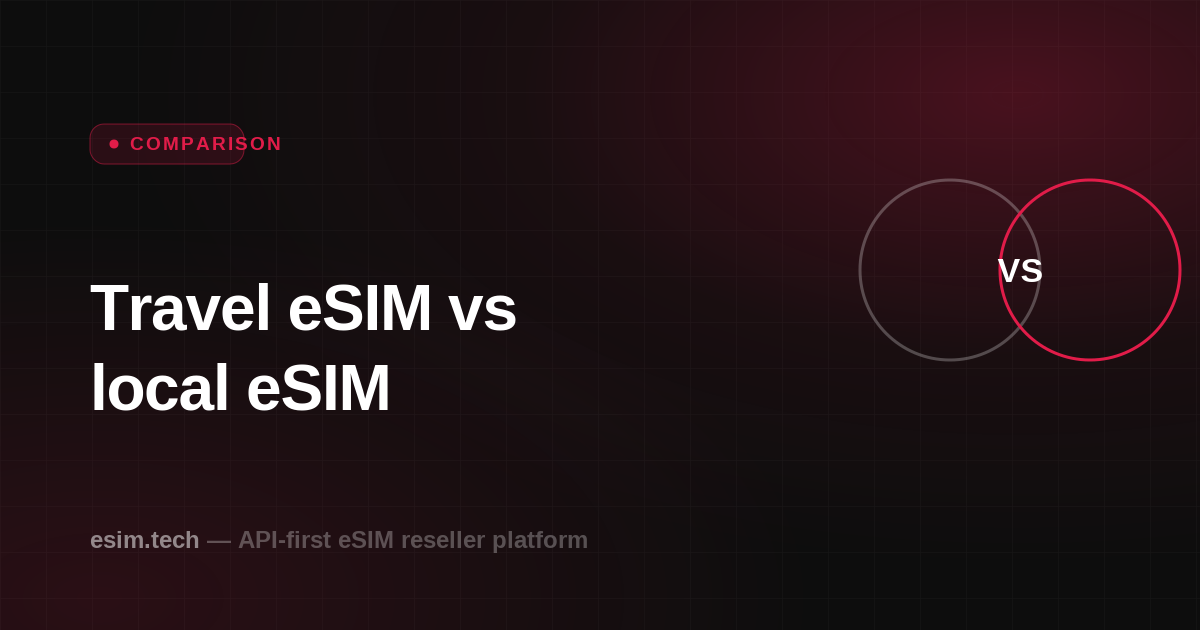
“eSIM” has become an umbrella term for two quite different products. If you’re choosing one for yourself, or deciding which to resell, the distinction matters more than any coverage map.
The short version
- A travel eSIM gives you data in one or many countries, usually via roaming arrangements. No phone number, no calls, no SMS.
- A local eSIM makes your phone a local subscriber: a real local phone number with voice, SMS, and data on the local network.
Side by side
| Travel eSIM | Local eSIM | |
|---|---|---|
| Phone number | None (data-only) | Real local mobile number |
| Voice & SMS | ❌ | ✅ |
| Bank/2FA SMS verification | ❌ | ✅ (real number, not VoIP) |
| Data | Fixed bundles (1–50 GB typical) | Unlimited plans or large bundles |
| Network identity | Often foreign/roaming breakout | Local breakout, so apps see you as local |
| Best for | Trips of days to weeks | Stays of weeks to years, expats, remote workers |
| Typical price | € (commodity) | €€ (differentiated) |
When a travel eSIM is the right choice
For a one-to-three-week holiday, a data-only travel eSIM is unbeatable. It’s cheap and instant, and WhatsApp and iMessage keep running over data. Multi-country bundles cover an entire itinerary with one profile. Pay-as-you-go travel data is built for this case, and with per-MB billing, light users don’t pay for gigabytes they never touch.
When you need a local eSIM
The travel eSIM model breaks down once you need to exist in a country rather than just visit it:
- You need to receive verification SMS. Banks, government portals, and delivery platforms send codes to mobile numbers, and most reject VoIP numbers outright. A local eSIM’s number is a genuine mobile MSISDN, so it works.
- You’re staying longer than a month. Unlimited local data beats stacking 10 GB travel bundles, both in price and convenience.
- People need to call you. Landlords, employers, schools, and doctors all need a number to reach you on.
- Apps must see you as local. Local streaming catalogues, banking apps, and marketplaces often behave differently (or refuse service) behind roaming breakouts.
That’s the expat, digital nomad, student, and remote-worker use case, which we cover in depth in selling eSIMs with local phone numbers.
Why this matters for resellers
The two products serve different customers with very different economics:
- Travel eSIMs are a volume game with 30–40% margins and heavy price competition.
- Local eSIMs solve harder problems, face far fewer competitors, and support 50–70% margins. Customers also keep their number, which makes the revenue recurring and sticky.
The strongest reseller portfolios carry both: travel data as the high-volume entry product, and local eSIMs as the high-margin upgrade for anyone staying longer.
Offer both from one API
eSIM.tech provides both product families behind a single REST API: pay-as-you-go travel data in 190+ countries, and local eSIMs with real phone numbers, voice, SMS, and unlimited data in 25+ countries. The activation code (and phone number) comes back instantly in the API response.
Start today at resellers.esim.tech.
Frequently asked questions
Can a travel eSIM receive SMS?
Usually not. Most travel eSIMs are data-only and have no phone number at all. If you need to receive SMS (for example bank verification codes), you need a local eSIM with a real phone number.
Which is cheaper, a travel eSIM or a local eSIM?
For a short trip, a travel data eSIM is cheaper. For stays of a month or more, or whenever you need a working local number, a local eSIM gives far more value: unlimited data plus voice, SMS, and a number you keep.
Can I have both at the same time?
Yes. Modern phones support multiple eSIM profiles. A common setup is a local eSIM for your number and primary data, with a travel eSIM added for trips to other countries.
Do local eSIMs work for tourists too?
Yes, though they suit longer stays best. Tourists staying a few weeks who need a local number (for restaurant bookings, delivery apps, or SIM-verified services) increasingly choose local eSIMs over data-only options.