eSIM for IoT and Fleets: One Connection Across Every Country
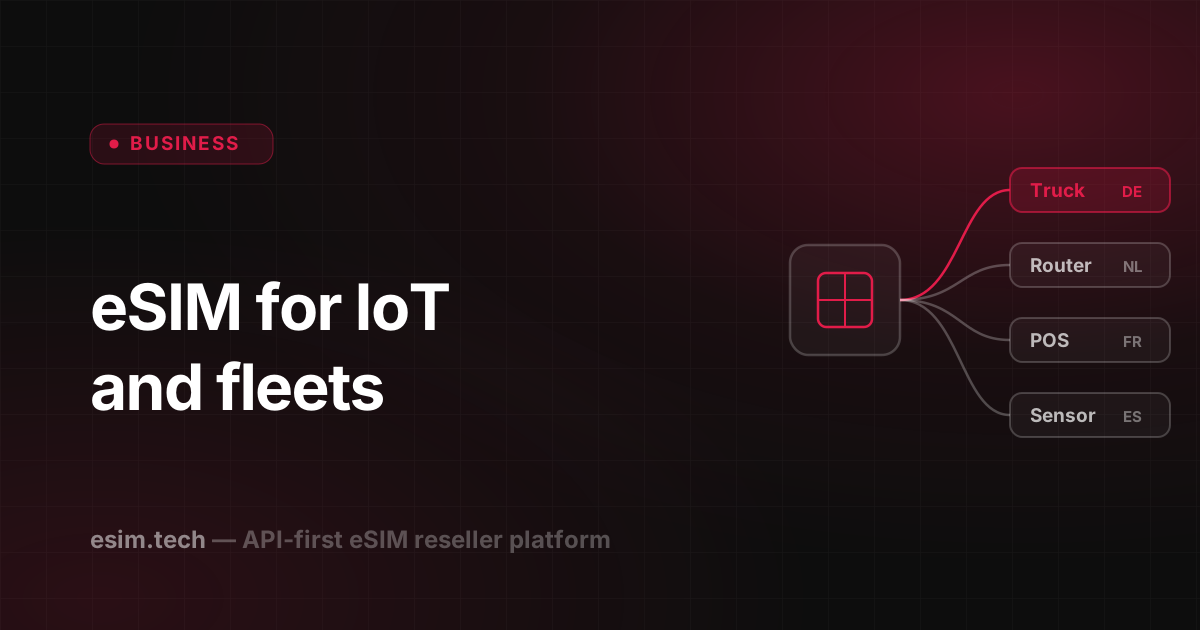
A delivery van, a bus with passenger Wi-Fi, a payment terminal at a festival and a sensor on a shipping container have one thing in common: they all need data, and they don’t stay in one place. For IoT and fleet companies, keeping every device online is a logistics problem in its own right.
This guide explains how eSIMs solve that, and what to check before you move a fleet over.
The problem with one contract per country
The traditional setup is a SIM card from a national operator in every country you operate in. That works until the devices start moving.
A truck that leaves Rotterdam on a Monday can be in four countries by Friday. On a single national SIM, it roams from the second country onward, at roaming rates and on whatever network the home operator has a deal with. A second contract in the next country means a second SIM, a second invoice and a second support desk.
Swapping physical SIMs in a fleet of hundreds of devices also means sending someone out to every device. That alone keeps many companies on a contract they’d rather leave.
How eSIM changes it
An eSIM is a profile that is downloaded onto a chip in the device instead of a plastic card. For a fleet, that means three things.
You can change the profile remotely. No technician visits, no swapped cards and no stock of SIMs per country.
One profile can cover many countries. A multi-IMSI eSIM carries several network identities and switches to the best one per country. eSIM.tech reaches 494 networks in 190+ countries this way.
And you have one supplier. One contract, one API, one invoice, whichever country the device is in.
Reliability: what happens when a network fails
For a payment terminal or a vehicle tracker, “offline for an hour” is a real cost. Multi-IMSI lets you set a network policy per country:
- All networks. The device may use every available network. If one has an outage, it moves to another. This is the right choice for anything business-critical.
- Cheapest only. The device stays on the lowest-cost network. That suits sensors that send a little data and can wait a few minutes.
For fixed locations, such as a shop, a warehouse or a construction site office, a 5G backup eSIM takes over within 8 seconds when the fixed line fails, with Priority 1 access on the mobile network.
Security: static IP and VPN
Most IoT devices shouldn’t be reachable from the open internet. And many back-end systems only accept connections from known IP addresses.
With eSIM.tech’s business connectivity, each device can get its own static IP. Traffic can run through a VPN tunnel straight into your own network, and you choose where traffic breaks out to the internet. You can also set policies per device, such as which destinations it may reach and how much data it may use.
That combination means your back-end sees every device at a fixed address, and nobody else sees them at all.
High-capacity data for routers
Some fleet devices use far more data than a sensor. Think of routers that give passengers Wi-Fi on a coach, MiFi devices for field teams, or video uploads from a vehicle camera.
For those, EU data SIMs offer bundles of up to 500 GB that work in all 27 EU member states. They are built for on-board routers and MiFi, with data hosted and processed in the EU.
Billing that fits mixed fleets
A fleet rarely consists of identical devices. A tracker might use 20 MB a month while a router uses 200 GB. Buying the same bundle for each makes no sense.
With pay-as-you-go billing, you pay per megabyte actually used across all devices. Unused balance doesn’t expire, and you can top up through the API.
Webhooks send usage events in real time. You can use them to spot a device that suddenly uses ten times its normal data, which is often the first sign that something’s wrong with it.
Consumer eSIM vs IoT eSIM standards
There are two eSIM standards worth knowing about.
The consumer standard, SGP.22, installs a profile from a QR code or activation code. It’s what phones, tablets and most routers and MiFi devices with eSIM support today.
The newer IoT standard, SGP.32, is designed for devices without a screen or user, and lets a platform manage profiles remotely at scale. Device support is still growing.
In practice, most fleets today run on devices that accept an activation code, either installed by the installer or pushed by the device’s management software. Ask your hardware supplier which standard their devices support before you choose.
A checklist before you switch
- Which devices support eSIM, and which standard do they use?
- Which countries do the devices operate in, and how much do they move between them?
- Which devices are business-critical and need failover?
- Do your systems need static IPs or a VPN to reach the devices?
- How much data does each device type use per month?
- Do you need data to stay in the EU for GDPR or customer contracts?
With those answers, a provider can tell you exactly which product fits each device type.
Getting started
Most companies start with a pilot: ten to fifty devices in the countries that cause the most trouble today. That shows real data use, failover behaviour and costs before you move the rest of the fleet.
Contact our team with your device types and countries, and we’ll come back within one business day with the setup and pricing that fit.
Can one eSIM work in vehicles that cross borders?
Yes. A multi-IMSI eSIM carries several network identities and switches to the right one in each country. A truck driving from the Netherlands to Spain stays on the same eSIM and the same contract the whole way.
What happens when a mobile network goes down?
With an 'all networks' policy, the eSIM may use every available network in a country. If one network has an outage, the device moves to another one automatically.
Can IoT devices on eSIM get a static IP address?
On eSIM.tech, yes. Each device can get a static IP, and traffic can run through a VPN tunnel to your own infrastructure, so the devices are reachable from your systems and invisible to the open internet.
How is IoT data billed?
Per megabyte actually used, across all devices. You don't buy a bundle per device, so a sensor that sends a few kilobytes a day doesn't cost the same as a router serving passenger Wi-Fi.