Multi-IMSI Explained: One eSIM, the Best Network in Every Country
A travel eSIM that works in 190+ countries relies on a technique called multi-IMSI: one eSIM profile that carries several network identities and picks the right one for wherever the customer is. If you resell connectivity, it’s the reason one product can cover the world.
First: what an IMSI is
Every SIM has an IMSI, short for International Mobile Subscriber Identity. It’s the number the network uses to recognise the SIM, and it encodes which operator the subscriber belongs to.
That home operator decides almost everything:
- Which networks the SIM may use abroad, through its roaming agreements
- What each megabyte costs on those networks
- Which countries work at all
A normal SIM has one IMSI, so it’s limited to the roaming deals of one operator. In a country where that operator has no deal, or a bad one, the SIM is either offline or expensive.
What multi-IMSI changes
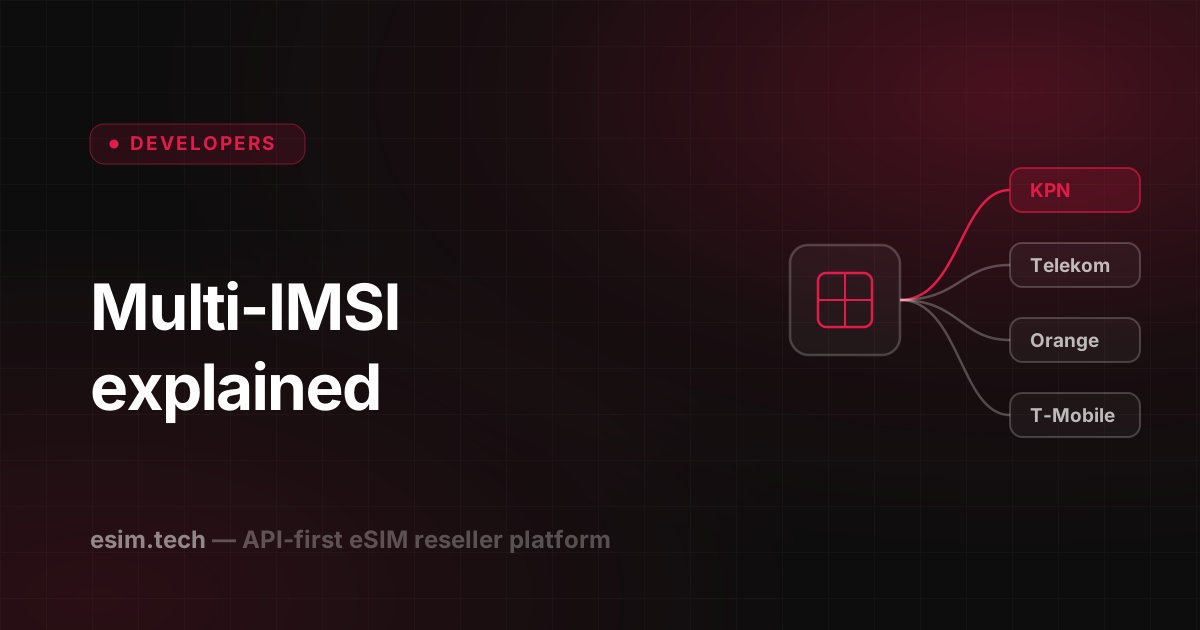
A multi-IMSI eSIM carries several IMSIs on the same profile, each from a different home operator. A small program on the SIM switches between them based on rules, typically the country the device is in.
So instead of one operator’s roaming map, the eSIM gets the combined reach of all its IMSIs. One profile can then connect to hundreds of networks: eSIM.tech’s Pay As You Go eSIM reaches 494 networks in 190+ countries this way.
How switching works in practice
- The customer lands in a new country and turns on their phone.
- The SIM detects the country from the networks it can see.
- It switches to the IMSI with the best access there, according to the rules set for that eSIM.
- The device registers on the chosen network and data starts flowing.
The customer keeps the same eSIM, the same QR code and the same plan. At most they notice a short reconnect when crossing a border.
Choosing networks: cheapest or all
Because the platform knows which networks are available per country, multi-IMSI also lets you set a network policy:
- Cheapest only: the eSIM uses the lowest-cost network in each country. That’s best for margin on price-sensitive plans.
- All networks: the eSIM may use every available network, so if one goes down it moves to another automatically. That’s best for reliability, such as business customers or long stays.
On eSIM.tech you choose per country. For example, in the Netherlands an eSIM can run on KPN with Vodafone and Odido on standby, and switch if KPN has an outage.
Why this matters for resellers
Without multi-IMSI you’d need a separate SIM product for every region. With it, one eSIM covers your whole market and you build plans on top of it.
Billing can follow real usage. Because the platform sees which network carried each megabyte, it can bill per MB instead of selling prepaid bundles, so you can sell your customer a 20 GB plan and only pay for the data they actually use. More on that model in our reseller business model guide.
You also design the plans yourself. Combine countries into your own zones, such as “Europe” or “North America”, and set the price and validity per zone. You can sell unlimited plans with speed tiers too, which keeps your costs predictable.
Uptime improves as well: with the “all networks” policy, a network outage in one country doesn’t take your customers offline.
Multi-IMSI vs local eSIMs
Multi-IMSI is ideal for data across many countries. It isn’t the right tool when a customer needs to look local, with a real local phone number for SMS verification, banking or calls. For that you use a local eSIM, issued directly by an operator in the country itself. Many resellers offer both: multi-IMSI data for trips, and local eSIMs for people who stay. We compare the two in travel eSIM vs local eSIM.
Frequently asked questions
What is an IMSI?
The IMSI (International Mobile Subscriber Identity) is the number a mobile network uses to recognise a SIM. It says which operator the subscriber belongs to, and that decides which networks the SIM may use and at what price.
What is a multi-IMSI eSIM?
A multi-IMSI eSIM carries several IMSIs, each from a different home operator, on one profile. The SIM switches to the identity that gives the best access or price in the country where the device is, without the customer doing anything.
Does the customer notice when the IMSI switches?
Normally not. The switch happens on the SIM and the network, typically when the device enters a new country. At most there's a short reconnect; the customer keeps the same eSIM.
Is multi-IMSI the same as a multi-network SIM?
They're related but not identical. A single-IMSI SIM can still roam on several networks in a country. Multi-IMSI adds extra identities, so the SIM can reach networks and rates that one home operator alone couldn't offer.