How Travel Agencies and Tour Operators Can Sell eSIMs
Every traveller you book will need mobile data at the destination. Most of them sort it out themselves: they pay roaming fees, buy a SIM at the airport or download a random eSIM app the night before they fly. If you’re a travel agency or tour operator, that is revenue and goodwill going to someone else at a moment you already own.
This guide covers how agencies and tour operators add eSIMs to what they sell, from the first offer to the support questions after landing.
Why eSIMs fit a travel agency
You already know where the customer is going, for how long and when they leave. That’s everything you need to offer the right data plan without asking a single extra question.
It also solves a problem your customers will otherwise bring back to you. Roaming bills and “my phone didn’t work” stories end up in reviews of the trip, even when the agency had nothing to do with it. An eSIM sent with the travel documents takes that off the table.
And the margin is real. Travel data typically leaves room for a 30–45% margin, which we break down in our reseller business model guide. On a product that costs you nothing to stock, that adds up quickly across a season of bookings.
When to offer it
There are three moments in the booking journey where an eSIM offer makes sense.
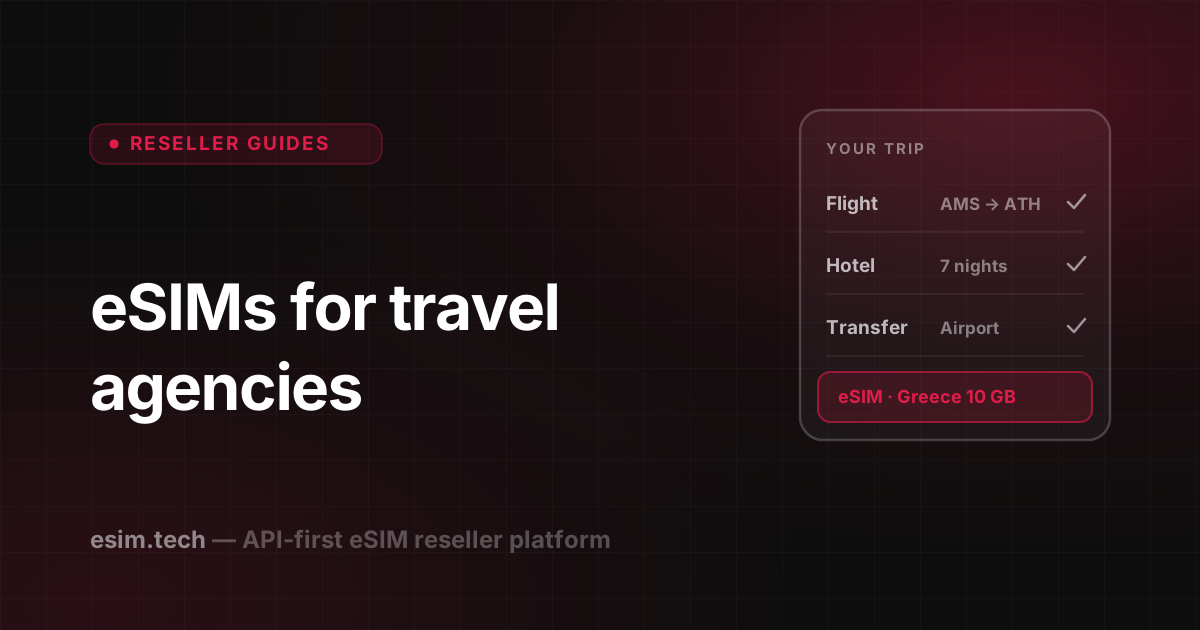
- At checkout. Add it as an option next to insurance and transfers. The destination and dates are known, so the plan can be pre-selected.
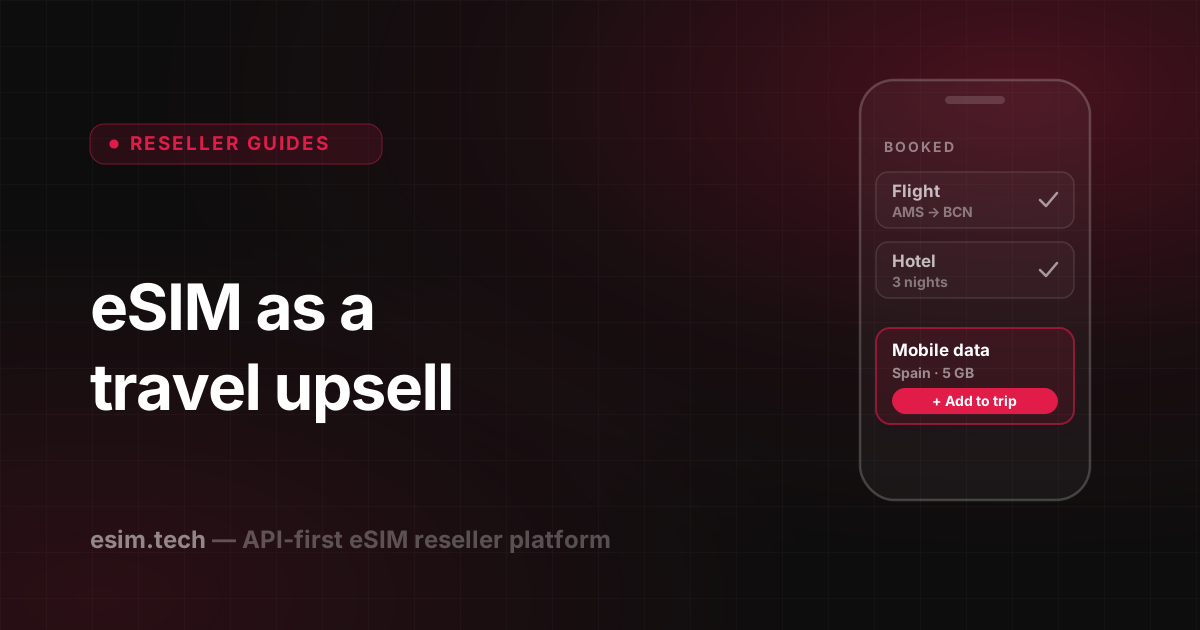
- In the pre-departure email. Three to seven days before the trip, the traveller is reading everything you send. That’s the moment to deliver the QR code with short installation steps.
- On the booking page or app. Travellers who skipped it at checkout often come back to check their documents. A visible “add mobile data” button catches them.
Most agencies start with the pre-departure email, because it needs the least change to the booking flow.
Which products to offer
Data for one destination
The simplest product: a data plan for one country, sized to the length of the stay. A week in Italy needs a different plan than three weeks in Japan, and you already know which one the customer booked.
Multi-country tours
A round trip through Vietnam, Cambodia and Thailand, or a cruise along the Mediterranean, needs one eSIM that works in every stop. A multi-IMSI eSIM covers that with a single QR code. On eSIM.tech you can group countries into your own zones, such as “Southeast Asia” or “Mediterranean”, and price each zone yourself.
Long stays and study trips
Customers who stay for months, such as students, interns or people on a working holiday, often need a real local phone number for banking apps and SMS verification. A local eSIM with a number in the country itself is the better product for them. We explain the difference in travel eSIM vs local eSIM.
Group tours
For groups, you can provision one eSIM per participant in a single batch and send them with the group’s travel documents. The tour leader no longer has to help twenty people find Wi-Fi on day one.
How to price it
You have two options.
Include it in the package. The trip feels complete, there’s no extra decision at checkout, and it makes your package stand out against the same hotel and flight sold elsewhere. You build the cost into the package price.
Sell it as an optional add-on. The headline price stays lower, the eSIM earns its own margin, and you can offer a few sizes, such as 5 GB, 10 GB and unlimited.
Whichever you pick, keep it simple. Three choices at most, with names that describe the use, such as “Light”, “Standard” and “Unlimited”.
How delivery works
With eSIM.tech, your booking system calls the API when the customer pays or a few days before departure. The response comes back in about 120 ms and contains the QR code and the activation code (the LPA code). You put both in your own email or app, with your logo and your wording.
There’s no stock to manage, no minimum order and no contract. You pay for the eSIMs you actually issue. If you have developers or a booking platform partner, the API integration guide shows the calls step by step.
Support: what travellers ask
Most questions come in three groups, and you can answer almost all of them before they’re asked.
- Does my phone support eSIM? Ask at booking, or link to the phone’s settings page where eSIM support shows. Phones locked to a home carrier can’t add another eSIM.
- When do I install it? At home, on Wi-Fi, a day or two before departure. Then switch data to the eSIM after landing.
- Why don’t I have data? Usually data roaming is off for the eSIM line. One sentence in your instructions saves most of these tickets.
Put these in the pre-departure email and you’ll handle few support tickets on the trip itself.
Getting started
You don’t need to rebuild your booking system. Start with one destination or one product line, send eSIMs with the pre-departure email, and measure how many travellers install them. Once that works, move the offer to checkout.
If you want to see what your margin would look like for your destinations, contact our team and we’ll send you the pricing within one business day.
Can a travel agency sell eSIMs under its own brand?
Yes. With a white-label platform such as eSIM.tech, the traveller sees your brand on the email, the app screen and the installation instructions. The eSIM itself is provisioned through the API and the QR code is delivered by you.
When should a travel agency send the eSIM to the customer?
A few days before departure works best. The traveller installs it at home on Wi-Fi, and it starts working when they land. Sending it at booking time is fine too, as long as the plan's validity doesn't start before the trip.
Should the eSIM be included in the package price or sold as an add-on?
Both work. Including it makes the package feel complete and avoids an extra choice at checkout. Selling it as an optional add-on keeps the headline price lower and lets you earn a separate margin on each eSIM.
What about travellers whose phone doesn't support eSIM?
Ask about the phone during booking or link to a compatibility check. Most phones sold in the last few years support eSIM, but some budget models and phones locked to a carrier don't, so offering a fallback such as a pocket Wi-Fi device avoids disappointment.