How Mobile Operators Can Win Back Roaming Revenue from Travel eSIMs
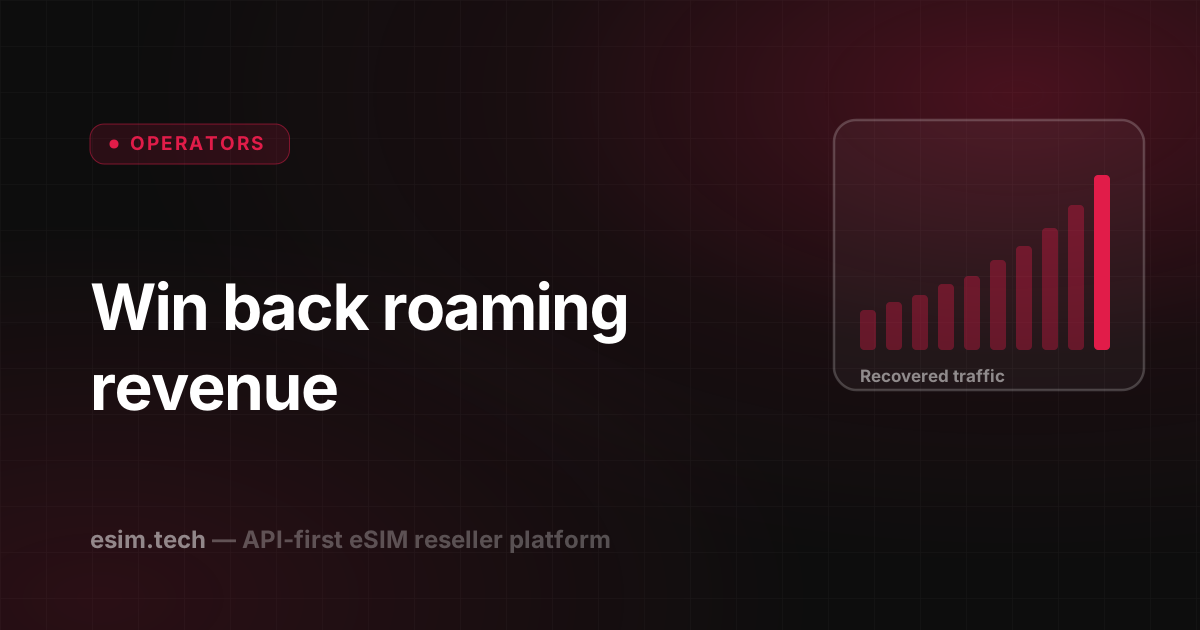
For years, an international visitor meant roaming revenue: their home operator paid yours for every megabyte they used on your network. Travel eSIMs have changed that flow. More and more travellers buy a data eSIM before they leave, and their traffic now lands on whichever networks the eSIM provider happens to have deals with. If that isn’t you, the revenue never shows up.
That traffic still exists, but it now arrives through new channels. This article explains where it goes and how an operator can win it back.
Where the traffic went
A traveller with a travel eSIM is no longer a roaming customer of their home operator. They’re a customer of an eSIM app, which is a reseller of a platform, which has wholesale agreements with a set of networks in each country.
For a host operator, that creates three problems:
- The demand is fragmented across hundreds of travel eSIM apps, IoT platforms and MVNOs, each buying capacity somewhere.
- The traditional roaming setup doesn’t reach them. Your bilateral roaming agreements cover other operators, not this new generation of resellers.
- Selling to each one directly doesn’t scale, because every reseller means another contract, another integration and another settlement process.
The option: one integration, many demand channels
Instead of signing with resellers one by one, an operator can connect once to a platform that aggregates the demand. That’s the model eSIM.tech works on. Our platform routes traffic from:
- Travel eSIM apps
- IoT platforms
- MVNEs and MVNOs
- Enterprise resellers
These channels reach 200+ resellers in total. Selling directly to 200 resellers means 200 contracts; through one platform it’s one.
Routing happens per session: eSIM.tech’s core uses multi-IMSI to choose a network based on rate, signal and country. If you want to know how that works on the SIM side, see multi-IMSI explained.
What the operator keeps control of
Selling through a platform only works if you stay in charge of your own network and prices. On eSIM.tech:
- You set per-country wholesale rates and can adjust them any time. Changes apply to all demand channels in real time.
- You get real-time dashboards on traffic and revenue.
- Settlement is automated monthly and auditable per session.
What going live looks like
From signed contract to live traffic usually takes about four weeks:
- Week 1, commercial: NDA and commercial framework. We share traffic forecasts; you share rate cards.
- Week 2, technical: interconnect via IPX, a cross-connect or an IPsec VPN, with SIGTRAN (SS7/MAP) and DIAMETER (S6a) signalling.
- Week 3, core elements: we provide the STP, DRA, HLR/HSS, PGW (CUPS), SMSC and USSD gateway. You provide the IMSI range.
- Week 4, go live: production traffic switches on. The first settlement runs at the end of the month.
Because the demand already exists, there’s no slow ramp-up: most supply partners see meaningful traffic within 48 hours of going live.
Who this is for
This model fits operators that:
- See fewer roaming visitors than their inbound tourism figures would suggest
- Have spare capacity, for example outside the tourist season or in specific regions
- Want a share of travel eSIM traffic without building a reseller channel themselves
- Want to keep pricing control rather than hand it to a single large buyer
Next step
Read more on our operator partnerships page, or contact our wholesale team to discuss rates and interconnect options.
Frequently asked questions
Why are operators losing roaming revenue to travel eSIMs?
Travellers increasingly buy a data eSIM before they leave instead of roaming on their home SIM. That traffic then lands on whichever networks the eSIM provider has agreements with. Operators without those agreements don't see it at all.
How can an operator sell capacity to travel eSIM providers?
Either by signing deals with eSIM platforms one by one, or by connecting once to an aggregator that routes demand from many resellers. With eSIM.tech, one integration gives access to travel eSIM apps, IoT platforms, MVNOs and enterprise resellers.
Who sets the wholesale rates?
The operator. On eSIM.tech you set per-country wholesale rates and can change them at any time; changes apply to all demand channels in real time.
How long does it take to go live?
Typically about four weeks from signed contract to live traffic: commercial terms, technical interconnect, core network elements, then production traffic. Most partners see meaningful traffic within 48 hours of going live.